


Green Attic is a commercial mold remediation company serving property owners and building managers across Chicagoland.
We handle mold problems in the attics and roof decks of office buildings, retail centers, condo buildings and light-industrial properties.

Commercial Mold Remediation Company in Chicagoland

Serving Chicagoland property owners since 2009.


Request a Quote Today
Please Fill Out the Form Below
First name *
Last name *
Email *
Phone *
Address, City, State, Zip *
Tell us more about your project
Get a Free Quote


Commercial Mold Removal and Remediation Services
for Offices, Retail and Industrial Buildings
Mold problems in commercial buildings can vary depending on the roof construction and how the space below is used. Green Attic’s commercial mold cleanup team works on attics and roof decks in office buildings, retail centers, condo buildings, warehouses, schools and light-industrial properties across Chicagoland.

Office Buildings

Commercial Plazas

Medical / Hospitals

Manufacturing Facilities

Multi-Family Units

Metal Buildings

Warehouses

Institutional / Schools
Our Commercial Mold Remediation Services
Removing mold from a commercial attic or roof deck takes more than applying a treatment to the wood. The affected surfaces need to be assessed, and the work area may need to be separated from occupied spaces below. Antimicrobial treatment or encapsulation may be appropriate after cleaning.
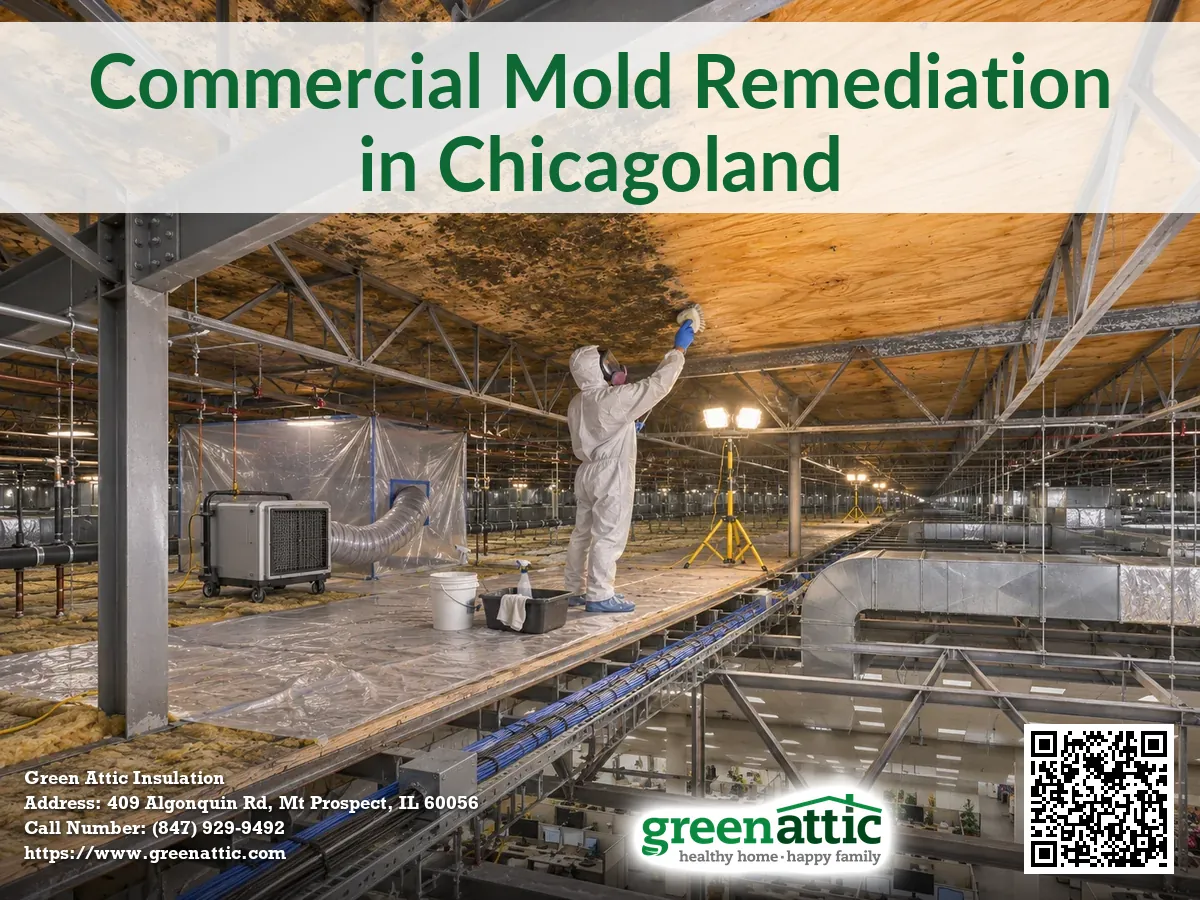
Mold Containment
We isolate the affected work area as needed to limit the spread of mold-contaminated dust. Depending on the project, containment may include HEPA-filtered air scrubbers and negative pressure.
Removal & Cleanup
Mold contamination is removed using appropriate cleaning methods, including HEPA vacuuming where needed. The condition of the sheathing and framing helps determine which materials can be cleaned.
Antimicrobial Treatment
Once the affected surfaces have been cleaned, antimicrobial treatment or encapsulation may be appropriate. These products are not a substitute for removing mold contamination.
Insulation
Wet or mold-contaminated insulation in commercial attics and roof assemblies may need to be removed so affected surfaces can be properly cleaned and dried. Learn more about our insulation removal services.
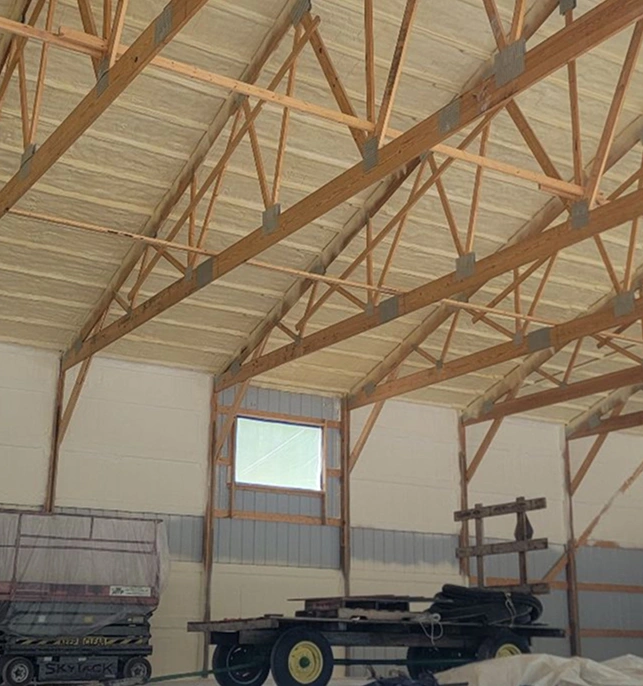
Fix the Cause With Ventilation, Air Sealing & Insulation
Commercial mold removal is only part of the solution when moisture continues to collect in the attic or roof deck. The conditions that caused the mold also need attention.
Air Sealing: We seal accessible gaps around ceiling penetrations that allow warm, humid indoor air to enter the attic. Reducing this airflow can help prevent condensation on cold roof surfaces.
Ventilation: We check existing soffit and ridge vents for blockages or other problems. If ventilation changes are needed, the approach depends on the attic and roof design. Powered ventilation should only be considered when it's suitable for the building.
Exhaust Fans: Restroom and kitchen exhaust ducts should discharge outdoors, not into the attic. Incorrectly terminated ducts may need rerouting.
Insulation: Once the moisture source has been addressed, damaged insulation can be assessed for replacement. Properly installed insulation helps reduce heat loss without blocking the intended ventilation paths.
Our Commercial Mold Cleanup Process
Our commercial mold remediation process starts with an inspection and a written scope of work. We then remove mold contamination using appropriate containment and cleaning methods, address the moisture source and complete a final inspection.
Step 1
Commercial Mold Inspection
We begin by inspecting the affected business property to assess the extent of mold growth. We also look for moisture issues that may be contributing to it.
The inspection may include moisture readings and checks around ceiling openings or exhaust ducts. Roof leaks and ventilation problems are also considered.
The inspection may include moisture readings and checks around ceiling openings or exhaust ducts. Roof leaks and ventilation problems are also considered.
Step 2
Get a Written Scope of Work
Once the affected areas have been assessed, we prepare a written scope of work and quote.The scope outlines the planned remediation and any containment needed.
It identifies which materials can be cleaned and which may need removal or replacement. It also explains the expected schedule and any moisture-related repairs included in the project.
It identifies which materials can be cleaned and which may need removal or replacement. It also explains the expected schedule and any moisture-related repairs included in the project.
Step 3
Remove the Mold Under Containment
We separate the work area as needed and remove the mold contamination using appropriate cleaning methods.
Depending on the materials involved, this may require HEPA filtration or removal of damaged material. Antimicrobial treatment or encapsulation may be used where appropriate after cleaning.
Depending on the materials involved, this may require HEPA filtration or removal of damaged material. Antimicrobial treatment or encapsulation may be used where appropriate after cleaning.
Step 4
Fix the Cause and Verify the Result
The moisture source needs to be addressed as part of the remediation work. That may involve air sealing or improving ventilation. If insulation was removed or damaged, it may also need replacing.
Affected materials should be adequately dried before replacement insulation is installed. A final inspection helps confirm that the planned work has been completed.
Affected materials should be adequately dried before replacement insulation is installed. A final inspection helps confirm that the planned work has been completed.
Where We Find Mold in Commercial Buildings

Roof Deck & Sheathing
Mold can grow on the underside of plywood or OSB roof decking when the wood stays damp. Recurring condensation and roof leaks are possible causes.

Attics Above Offices & Units
Attic spaces above tenant suites and condo units may go unchecked for long periods. By the time moisture damage becomes visible inside the building, mold may already have developed above the ceiling.

Exhaust Fans, Ducts & HVAC
Exhaust fans that discharge into an attic can introduce humid air directly into the space. Air-conditioning ducts with damaged or missing insulation may also develop condensation that drips onto nearby materials.

Metal Building Condensation
Metal roofs can develop condensation when humid air reaches a cold surface. If the insulation or vapor-control system isn't working properly, moisture may collect around the roof framing.

Top-Floor Ceilings & Musty Odors
Stained ceiling tiles or a musty smell may be the first signs of a moisture problem above an occupied space. An inspection can help identify where the moisture is coming from and whether mold is present.

Mold Found in Due Diligence
Mold may be identified during a property condition assessment before a sale, lease or refinancing. In these cases, owners may need to establish the extent of the problem and the likely remediation work before proceeding.

Certified Mold Remediation Expertise

Dumitru Nicolaescu
Certified Mold Remediator (CMR)
Certified by the Professional Mold Inspection Institute (PMII) Certificate #CMR0000051619, awarded August 2026.
Our commercial mold remediation work is backed by PMII-certified training in mold identification, containment and remediation, including finding the moisture problem and handling affected materials. [CONFIRM: Dumitru's direct oversight and sign-off responsibilities on every commercial project.]
What Is Commercial Mold Remediation?
Commercial mold remediation is the process of removing mold from commercial or multi-unit buildings while addressing the moisture problem that caused it. Depending on the extent of the contamination, the work may also require containment to prevent mold-contaminated dust from spreading into other parts of the building.
Commercial Mold Inspection
Identifies the affected areas and possible moisture sources.
Commercial Mold Cleanup
Deals with contamination on surfaces that can be cleaned.
Commercial Mold Removal
May also involve taking out damaged materials.
Commercial Mold Remediation
Brings the necessary work together, with the aim of reducing the risk of mold returning.
For homes, see our residential attic mold removal page.
Key Facts About Commercial Mold
Cause
Mold needs moisture to grow. In commercial attics and roof decks, one possible source is winter condensation. Warm indoor air can escape through ceiling openings and leave moisture on the cold underside of the roof.
Timing
The U.S. EPA recommends drying wet building materials within 24–48 hours to help prevent mold growth.
Humidity
The EPA recommends keeping indoor relative humidity below 60%, ideally between 30% and 50%. These recommendations apply to indoor spaces, not as fixed targets for vented attics.
Standard
ANSI/IICRC S520:2024 distinguishes between Condition 1 (normal fungal ecology), Condition 2 (settled spores dispersed from an area with actual mold growth) and Condition 3 (actual mold growth). Remediation aims to return affected areas to Condition 1.
Registration
Illinois has registration requirements for mold remediators through the Illinois Department of Public Health (IDPH), subject to certain exemptions. Transitional certification provisions for eligible remediators extend through September 30, 2027.
EPA Guidance for Different Mold-Affected Areas
The size of the affected area helps determine the precautions needed during remediation. The EPA provides general guidance for different levels of mold contamination.
| EPA job size | Affected area | What EPA guidance generally recommends |
|---|---|---|
| Small | Under 10 sq. ft. | Appropriate personal protective equipment (PPE). Containment is usually not needed for an uncomplicated small area. |
| Medium | 10–100 sq. ft. | Limited containment to help separate the affected area from the rest of the building. |
| Large | Over 100 sq. ft. | Full containment is generally recommended. A larger or more complicated project may also call for an experienced independent professional. |
These are general recommendations rather than requirements for every project. The building's conditions and the potential exposure of occupants also need to be considered.
Sources: U.S. EPA, Mold Remediation in Schools and Commercial Buildings; ANSI/IICRC S520:2024; IDPH Mold Remediation Registration.
Commercial Mold Remediation FAQ
How Much Does Commercial Mold Remediation Cost in Chicago?
The cost of commercial mold remediation in Chicago depends on the size of the affected area and how much damage the mold has caused. Mold that's limited to an accessible surface may require less work than growth hidden behind walls or above ceilings.
A professional assessment can help determine what needs to be done before an accurate estimate is prepared.
A professional assessment can help determine what needs to be done before an accurate estimate is prepared.
Is Mold Testing Necessary Before Commercial Mold Remediation?
Mold testing isn't always necessary before commercial mold remediation. When mold growth is clearly visible, testing may not be needed to confirm there's a problem.
However, a professional assessment is still important to understand how far the mold has spread and where the moisture is coming from. Testing may be useful when the source is unclear or additional documentation is needed.
However, a professional assessment is still important to understand how far the mold has spread and where the moisture is coming from. Testing may be useful when the source is unclear or additional documentation is needed.
What Does Commercial Mold Remediation Involve?
Commercial mold remediation involves removing mold growth and dealing with the moisture problem that allowed it to develop. Depending on the affected area, the work may require containment to keep mold-contaminated dust from spreading through the building.
Some materials can be cleaned, while badly damaged materials may need replacing. Simply applying a mold treatment won't prevent the problem from returning if the moisture source remains.
Some materials can be cleaned, while badly damaged materials may need replacing. Simply applying a mold treatment won't prevent the problem from returning if the moisture source remains.
Can a Business Stay Open During Commercial Mold Removal?
A business may be able to stay open during commercial mold removal if the affected area can be safely separated from occupied spaces. It depends on how much mold is present and where the work needs to happen.
Larger projects may require temporary restrictions or closing part of the building. These concerns should be addressed in the remediation plan before work begins.
Larger projects may require temporary restrictions or closing part of the building. These concerns should be addressed in the remediation plan before work begins.
How Can You Prevent Mold From Returning After Commercial Remediation?
Preventing mold from returning after commercial remediation starts with fixing the moisture problem that caused it. This could mean repairing leaks or correcting ongoing condensation.
It's also worth checking areas that have experienced water damage, since new mold can develop if those materials stay damp. Removing existing growth is only part of the solution.
It's also worth checking areas that have experienced water damage, since new mold can develop if those materials stay damp. Removing existing growth is only part of the solution.
Service Areas
Northwest Suburbs

North Shore
Learn More


