


Commercial Spray Foam Insulation in Chicagoland
Green Attic provides high-performance spray foam insulation across Chicagoland, cutting energy costs and enhancing comfort in commercial and industrial spaces.

Trusted by homeowners for reliable, energy-saving insulation solutions.




Request a Quote Today
Please Fill Out the Form Below
First name *
Last name *
Email *
Phone *
Address, City, State, Zip *
Tell us more about your project
Get a Free Quote



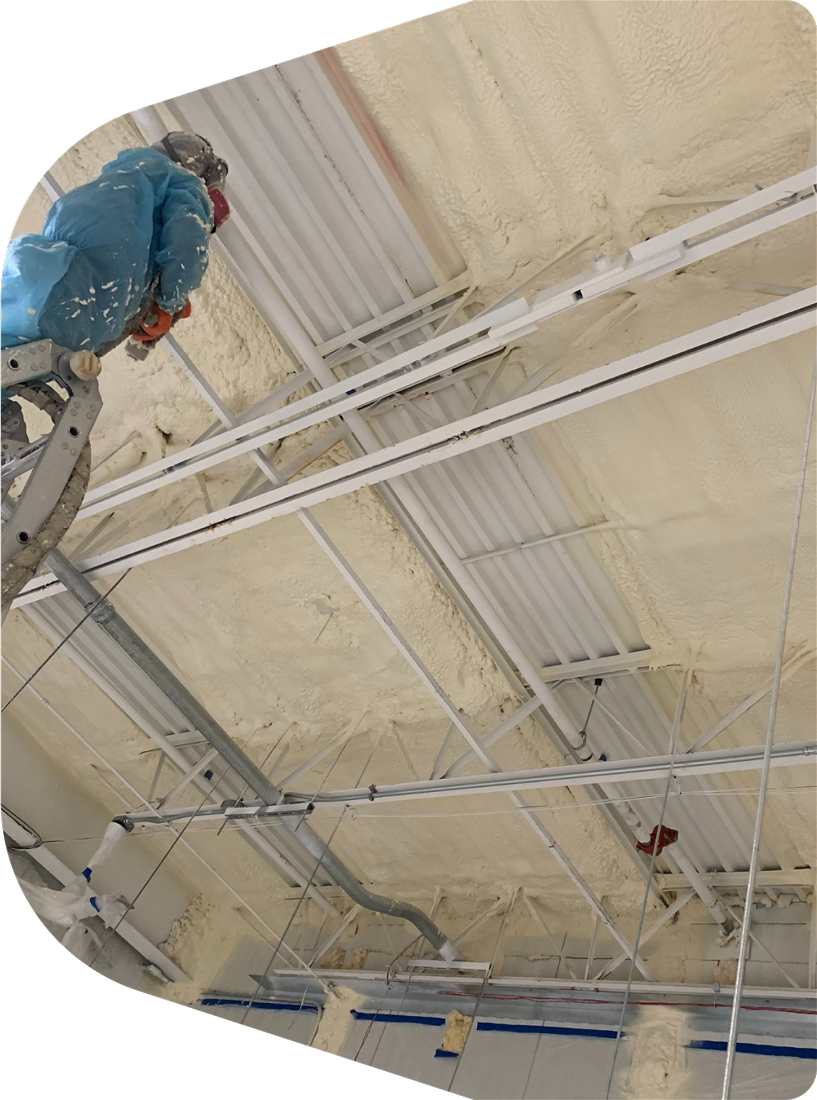
Benefits of Commercial Spray Foam Insulation

Lower Energy Costs
Seals air leaks and provides superior insulation, reducing heating and cooling expenses year-round.

Consistent Indoor Comfort
Eliminates drafts and hot/cold spots, creating a stable environment for employees, customers, and tenants.

Noise Reduction
Creates an airtight barrier that prevents moisture intrusion, lowering the risk of mold growth and building damage.

Moisture & Mold Control
Reduces emissions by replacing fossil-fuel systems, especially when powered by renewable electricity.

Longer Building Lifespan
Strengthens walls, roofs, and structures by adding rigidity, protecting your investment for the long term.

Improved Indoor Air Quality
Reduces entry of dust, pollen, and pollutants, promoting a healthier workspace.
179D Tax Deduction for Commercial Spray Foam
Qualifying commercial spray foam projects may be eligible for the IRS Section 179D building envelope deduction, worth up to $5.65 per square foot. Because of the June 30, 2026 deadline, construction needs to begin soon to secure this benefit under current law.
Maximum deduction rate
$5.65/sq ft
Base deduction rate
$0.57/sq ft
Construction deadline
Jun 30, 2026

Deadline alert: Construction must begin before June 30, 2026 to qualify under current law.
Green Attic provides the project documentation your tax advisorneeds to support a 179D certification claim. Consult a qualifiedtax professional to confirm eligibility.
See All Rebates and Incentives
Choosing the Right Spray Foam for Your Commercial Building
Both open-cell and closed-cell spray foam deliver excellent insulation, but each is suited to different needs. Understanding the differences helps you choose the best option for your building’s performance and budget.
Open Cell Spray Foam
- Cost-effective for interior walls and ceilings
- Expands to seal gaps and irregular cavities
- Strong sound absorption with drying potential
- Lightweight and easy to trim around MEPs
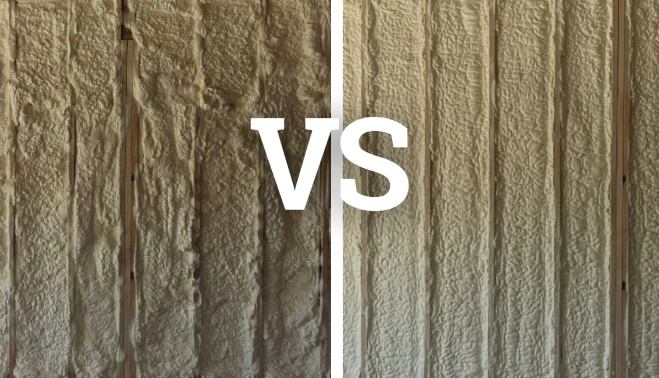
Closed Cell Spray Foam
- High R-value per inch with air and vapor control
- Adds rigidity to walls and roof decks
- Durable and moisture resistant for tough environments
- Helps control condensation on metal skins
Commercial and Industrial
Properties We Serve

Office Buildings

Commercial Plazas

Medical / Hospitals

Manufacturing Facilities

Multi-Family Units

Metal Buildings

Warehouses

Institutional / Schools
Types of Spray Foam Insulation
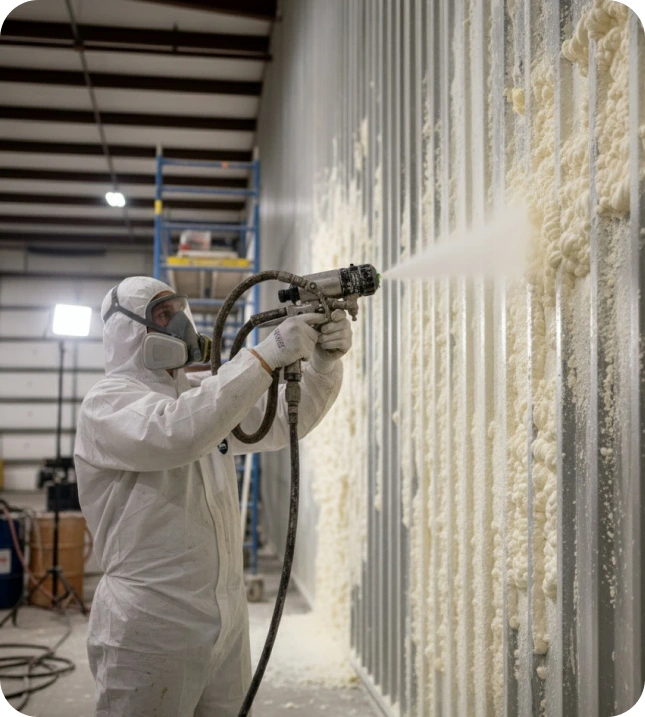
Open-Cell Spray Foam for Commercial Buildings
Open-cell spray foam is lightweight and flexible, expanding significantly to fill cavities and provide excellent sound absorption.
Its open-bubble structure allows limited air and moisture movement, making it best for interior use in conditioned spaces.️
Lightweight & Expansive: Fills gaps and cavities effectively.️
Sound Absorption:Reduces noise transfer between offices and interior spaces.️
Cost-Efficient: More affordable for large interior areas.️
Best For: Interior walls, ceilings, and partitions in offices, retail, schools, and other conditioned spaces.
Its open-bubble structure allows limited air and moisture movement, making it best for interior use in conditioned spaces.️
Lightweight & Expansive: Fills gaps and cavities effectively.️
Sound Absorption:Reduces noise transfer between offices and interior spaces.️
Cost-Efficient: More affordable for large interior areas.️
Best For: Interior walls, ceilings, and partitions in offices, retail, schools, and other conditioned spaces.
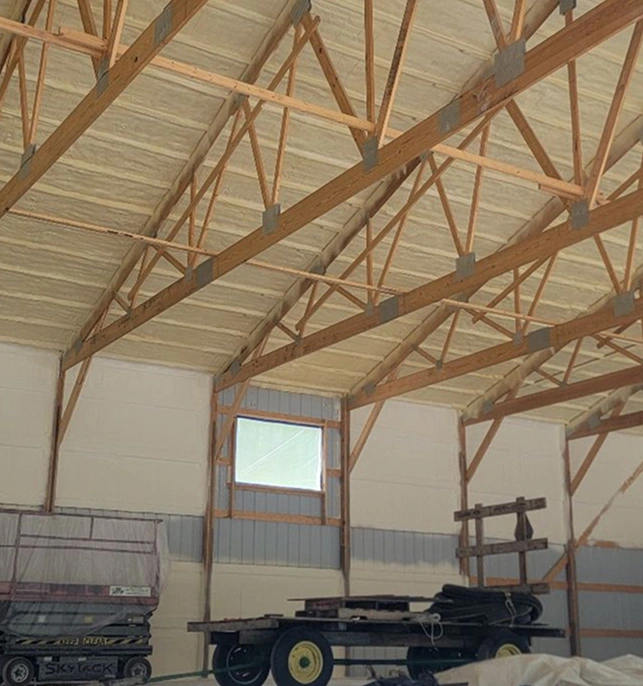
Closed Cell Spray Foam
Closed-cell spray foam is dense and rigid, creating a strong, moisture-resistant barrier with a higher R-value per inch.
It also reinforces the structure, making it ideal for exterior applications and demanding environments.️
High Insulation Value: Offers superior R-value per inch for energy efficiency.️
Moisture & Vapor Barrier:Protects walls, roofs, and other exposed areas.️
Adds Structural Strength: Reinforces walls and roofs in large buildings.️
Best For: Exterior walls, flat or sloped roofs, warehouses, industrial spaces, and cold storage facilities.
It also reinforces the structure, making it ideal for exterior applications and demanding environments.️
High Insulation Value: Offers superior R-value per inch for energy efficiency.️
Moisture & Vapor Barrier:Protects walls, roofs, and other exposed areas.️
Adds Structural Strength: Reinforces walls and roofs in large buildings.️
Best For: Exterior walls, flat or sloped roofs, warehouses, industrial spaces, and cold storage facilities.
Our Proven Process
Step 1: Assessment
We evaluate your building’s structure, insulation needs, and energy performance. Our team identifies air leaks, moisture concerns, and areas where spray foam will deliver the greatest impact.
Step 2: Planning
You’ll receive a tailored insulation plan that considers your building’s size, use, and budget. We select the right spray foam type, open-cell or closed-cell, to ensure optimal efficiency and durability.
Step 3: Installation
Our certified team applies spray foam with precision and efficiency, minimizing disruption to your operations and ensuring lasting performance.
Step 4: Results
Enjoy measurable improvements: lower energy costs, enhanced comfort, better indoor air quality, and long-term protection for your commercial property.
Get a Free Consultation
Frequently Asked Question
How much does it cost to spray foam a 40x60 building?
Spray foaming a 40x60 building (about 2,400 sq ft footprint) typically costs $4,500 to $22,100+, and that range is a plus because it lets you choose the foam type and thickness that best match your comfort, durability, and energy-saving goals, with many complete walls-and-roof projects commonly around $13,000 to $18,000 for 2-inch closed-cell foam.
Pricing stays flexible based on foam type, thickness (for a higher R-value), total surface area (often 4,500 to 4,900 sq ft for walls and roof), and job complexity, such as tall walls or lift requirements, so you can match the setup to your comfort and efficiency goals.
Pricing stays flexible based on foam type, thickness (for a higher R-value), total surface area (often 4,500 to 4,900 sq ft for walls and roof), and job complexity, such as tall walls or lift requirements, so you can match the setup to your comfort and efficiency goals.
Is the lack of proper insulation causing my roof, HVAC system, or framing to deteriorate more quickly than it should?
Yes, the lack of proper insulation is causing your roof, HVAC system, or framing to deteriorate more quickly than it should, and the good news is that upgrading insulation helps your HVAC run smoother with less strain while reducing attic temperature swings and moisture buildup, which supports a longer-lasting roof and healthier, stronger framing.
With proper insulation, your HVAC system runs more smoothly with less strain, and your roof and structural wood are better shielded from condensation, mold, and rot, which supports a longer service life. If you are seeing high energy bills, uneven temperatures, or attic moisture, improving insulation is a positive, high-impact fix.
With proper insulation, your HVAC system runs more smoothly with less strain, and your roof and structural wood are better shielded from condensation, mold, and rot, which supports a longer service life. If you are seeing high energy bills, uneven temperatures, or attic moisture, improving insulation is a positive, high-impact fix.
Is spray foam insulation durable and safe enough for my commercial building type?
Yes, spray foam insulation is highly durable and safe for most commercial building types, often lasting 60 to 100 years when installed correctly. Once it cures, it becomes inert and stable, while delivering strong insulation and air sealing that can support long-term energy savings.
For best results and easy compliance, spray foam can be finished with a code-approved thermal barrier like gypsum board or an intumescent coating, and a qualified installer will make sure the mix, coverage, and curing are done correctly. That combination delivers a clean, consistent application that performs reliably for years while keeping your building safe and up to code.
For best results and easy compliance, spray foam can be finished with a code-approved thermal barrier like gypsum board or an intumescent coating, and a qualified installer will make sure the mix, coverage, and curing are done correctly. That combination delivers a clean, consistent application that performs reliably for years while keeping your building safe and up to code.
Will better insulation help reduce noise transfer between tenants or units in a mixed-use commercial property?
Yes, better insulation can help reduce noise transfer between tenants or units in a mixed-use commercial property by absorbing sound waves and reducing vibrations that travel through shared walls, floors, and ceilings.
Acoustic-focused options like mineral wool or high-density fiberglass work especially well, and results improve even more when you pair insulation with simple upgrades like sealing gaps or adding resilient channels. You will also get the bonus of better energy efficiency and comfort for every unit.
Acoustic-focused options like mineral wool or high-density fiberglass work especially well, and results improve even more when you pair insulation with simple upgrades like sealing gaps or adding resilient channels. You will also get the bonus of better energy efficiency and comfort for every unit.
Service Areas
Northwest Suburbs

North Shore
Learn More


